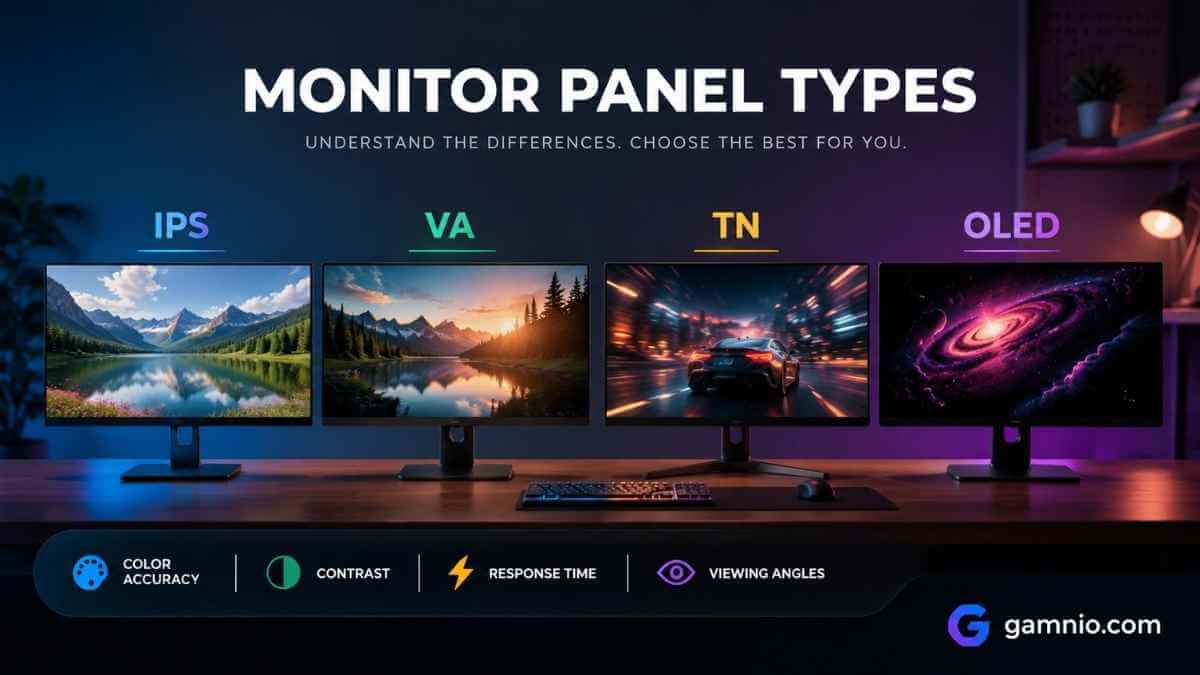
Choosing the right display starts with understanding monitor panel types. The panel technology inside a monitor affects color accuracy, contrast, response time, viewing angles, and overall image quality. IPS, VA, TN, and OLED panels each offer different advantages depending on how you use your screen. Whether you are a gamer, content creator, designer, or everyday user, knowing the differences between monitor panel types helps you choose the right display without depending only on marketing claims.
What Is a Monitor Panel Type?
A monitor panel type is the display technology used inside a monitor that controls how pixels produce images. It affects important factors such as color accuracy, contrast, response time, brightness, and viewing angles. The most common types are IPS, VA, TN, and OLED.
Most monitors use LCD (liquid crystal display) technology, where a backlight shines through a layer of liquid crystals that twist or align to control how much light passes through each pixel. IPS, VA, and TN are all LCD variants, differing mainly in how their liquid crystals are arranged, which changes speed, contrast, and color behavior.
OLED works differently: each pixel is self-emissive, meaning it produces its own light and can switch off entirely, without needing a backlight at all. This distinction between backlit crystals versus self-lit pixels is the reason panel type has such a large impact on real-world viewing experience, from how deep the blacks look to how sharp fast motion appears on screen.
Main Types of Monitor Panels
The four main monitor panel types are IPS, VA, TN, and OLED. IPS focuses on color accuracy, VA provides stronger contrast, TN prioritizes speed and affordability, and OLED delivers premium image quality through self-emissive pixels for advanced viewing experiences.
IPS (In-Plane Switching) Panels
IPS panels are known for strong color accuracy and wide viewing angles, since their crystal alignment keeps colors consistent even when viewed off-center. This makes IPS a popular choice for creators and general users who want reliable, accurate visuals.
VA (Vertical Alignment) Panels
VA panels are recognized for excellent contrast ratios and deeper black levels than IPS, since their crystal structure blocks light more effectively when pixels are off. They’re a common choice in gaming monitors and curved displays built around immersive viewing.
TN (Twisted Nematic) Panels
TN panels offer extremely fast response times and lower cost, thanks to their simple crystal structure. Their main weaknesses are color quality and viewing angles, which are the narrowest of any LCD panel type.
OLED (Organic Light-Emitting Diode) Panels
OLED panels use self-emissive pixels, producing true blacks and exceptional contrast since each pixel can turn off individually. This makes OLED popular for premium gaming and professional applications where image quality matters most.
IPS vs VA vs TN vs OLED: Comparison Table
This table compares IPS, VA, TN, and OLED across the categories that matter most for buyers: color, contrast, viewing angles, speed, black levels, price, and ideal use case, based on general industry patterns rather than exact lab figures.
| Feature | IPS | VA | TN | OLED |
|---|---|---|---|---|
| Color Accuracy | Excellent | Good | Average | Excellent |
| Contrast | Good | Excellent | Average | Outstanding |
| Viewing Angles | Excellent | Good | Poor | Excellent |
| Response Time | Very Good | Good | Excellent | Excellent |
| Black Levels | Good | Very Good | Average | Perfect |
| Price | Medium–High | Medium | Low | High |
| Best For | Design, gaming, work | Gaming, movies | Competitive gaming | Premium gaming/content |
This monitor panel comparison highlights that IPS and OLED lead in color, VA and OLED lead in contrast, and TN leads only in affordability; no single panel wins across every category, which is why matching the panel to your use case matters more than chasing one “best” spec.
Monitor Panel Types for Different Users (Quick Recommendation)
Here’s a fast, at-a-glance answer for anyone who just wants the right panel type for their use case: competitive gamers should look at fast IPS or TN, casual gamers should consider IPS or VA, movie lovers benefit from VA or OLED, designers should choose IPS, premium users should choose OLED, and budget buyers should pick VA or TN.
| User | Best Panel |
|---|---|
| Competitive gamer | Fast IPS / TN |
| Casual gamer | IPS / VA |
| Movie lover | VA / OLED |
| Designer | IPS |
| Premium user | OLED |
| Budget buyer | VA / TN |
This quick-reference table is a shortcut, not a rulebook; the sections below explain the reasoning behind each recommendation in more detail, so you can factor in room lighting, budget, and content mix before deciding.
IPS Panel Explained: Advantages and Disadvantages
IPS panels are known for accurate colors, wide viewing angles, and balanced performance across gaming, productivity, and creative work. They are a popular choice for users who need reliable image quality but still want good gaming performance.
Advantages of IPS Panels
IPS panels deliver accurate colors that stay consistent from nearly any viewing angle, which is a major advantage for shared viewing or side-seating arrangements. This wide, consistent viewing angle also supports a stable image quality whether you’re centered on the screen or off to one side. IPS panels are well suited to photo and video editing thanks to their color reliability, and they strike a good balance for both casual and competitive gaming, especially as modern high-refresh IPS panels have closed much of the speed gap with faster panel types.
Disadvantages of IPS Panels
The main drawback of IPS is lower contrast compared with VA and OLED, since blacks can appear more gray than truly dark, particularly in dim rooms. IPS glow, a faint haze visible in dark scenes, especially near the screen edges at an angle, is a known issue on many IPS panels. IPS monitors also tend to cost more than TN panels of similar size and refresh rate. In darker viewing environments, these limitations are the main tradeoff against IPS’s strong color and viewing-angle performance.
| Advantages | Disadvantages |
|---|---|
| Accurate, consistent colors from nearly any angle | Lower contrast than VA and OLED |
| Wide, stable viewing angles | IPS glow visible in dark scenes |
| Reliable for photo and video editing | Costs more than TN panels of similar spec |
| Good balance for casual and competitive gaming | Blacks can look more gray in dim rooms |
Best Uses for IPS Panels
IPS panels are well suited to graphic design, video editing, office work, and both casual and competitive gaming, making them one of the most versatile panel types available.
VA Panel Explained: Advantages and Disadvantages
VA panelsare designed for users who prioritize contrast and deeper blacks. They provide a more cinematic viewing experience than IPS in dark scenes, making them suitable for gaming, movies, and curved monitors, although some models have slower response times.
Advantages of VA Panels
The clearest VA panel advantage is contrast. A high native contrast ratio and deep blacks give VA panels a noticeably richer, more cinematic image, especially in dark scenes where IPS or TN panels can look washed out. This makes VA a strong choice for movie watching and for gaming genres with dim, atmospheric lighting. VA panels are also commonly used in curved gaming monitors, where their deep contrast pairs well with an immersive, wraparound viewing experience.
Disadvantages of VA Panels
The most cited VA panel disadvantage is response time, which has historically trailed behind TN and OLED, occasionally leading to visible smearing during fast motion. Some VA panels are also prone to black smearing, where dark objects moving over dark backgrounds leave a faint trailing effect. Viewing angles are weaker than IPS as well, with some color and contrast shift noticeable if you’re not seated directly in front of the screen. These limitations matter most for fast-paced competitive gaming, less so for movies or slower-paced titles.
| Advantages | Disadvantages |
|---|---|
| High native contrast ratio and deep blacks | Response time trails TN and OLED |
| Richer, more cinematic image in dark scenes | Can show black smearing in fast motion |
| Strong fit for movies and atmospheric gaming | Weaker viewing angles than IPS |
| Common in immersive curved monitors | Color and contrast shift off-center |
Best Uses for VA Panels
VA panels are well suited to gaming, watching movies, immersive single-player experiences, and curved gaming monitors, where their contrast strengths are most noticeable.
TN Panel Explained: Advantages and Disadvantages
TN panels are designed for speed-focused users who want fast response times, high refresh rates, and low latency at an affordable price. They are mainly used for competitive gaming, although they sacrifice color accuracy and viewing angles.
Advantages of TN Panels
TN panels offer very fast response times, strong support for high refresh rates, and low input latency, all of which appeal to competitive gamers chasing every advantage in reaction speed. Their simple construction also keeps pricing low, making TN panels the most affordable option for budget gaming setups.
Disadvantages of TN Panels
TN’s weaknesses are poor color reproduction and the narrowest viewing angles of any panel type, with noticeable shifts in color and contrast from even small changes in head position. Overall image quality also lags behind modern IPS, VA, and OLED panels, especially now that high-refresh IPS panels offer comparable speed with far better visuals.
| Advantages | Disadvantages |
|---|---|
| Very fast response times | Poor color reproduction |
| Strong support for high refresh rates | Narrowest viewing angles of any panel type |
| Low input latency | Noticeable color/contrast shift off-angle |
| Most affordable panel option | Overall image quality lags IPS, VA, OLED |
Best Uses for TN Panels
TN panels are best suited to competitive esports gaming, budget gaming setups, and players who prioritize speed over visual quality above all else.
OLED Panel Explained: Advantages and Disadvantages
OLED panels use self-emissive pixels that create their own light, allowing true blacks, exceptional contrast, and extremely fast response times. They offer premium image quality for gaming and media but come with higher prices and potential burn-in concerns.
Advantages of OLED Panels
Because OLED pixels generate and control their own light, an OLED gaming monitor can achieve perfect black levels and exceptional contrast, since bright and dark areas can sit side by side without backlight bleed. Response times are extremely fast, since organic pixels change state almost instantly, and OLED panels typically deliver excellent HDR performance thanks to their wide brightness range between deep blacks and vivid highlights. Overall, OLED represents premium image quality across gaming, movies, and general use.
Disadvantages of OLED Panels
OLED monitors carry a higher price than IPS, VA, or TN alternatives, and there is a real, though increasingly managed, risk of burn-in from static content like taskbars or HUD elements left on screen for long periods. Peak sustained brightness can also lag behind some high-end LCD panels, which matters in very bright rooms. These factors make OLED a stronger fit for varied, moving content than for long static workloads.
| Advantages | Disadvantages |
|---|---|
| Perfect black levels and exceptional contrast | Higher price than IPS, VA, or TN |
| Extremely fast, near-instant response times | Real risk of burn-in from static content |
| Excellent HDR performance | Peak sustained brightness can lag high-end LCD |
| Premium image quality across gaming and media | Less ideal for long static workloads |
Best Uses for OLED Panels
OLED panels are best suited to high-end gaming, professional content creation, and HDR gaming and entertainment, where their contrast and color strengths are most valuable.
Which Monitor Panel Type Is Best for Gaming?
The best monitor panel for gaming depends on the player’s priorities. IPS offers the best overall balance, TN and fast IPS suit competitive gaming, VA provides immersive contrast, and OLED delivers premium visuals with excellent HDR performance.
Best Overall Gaming Panel
For most gamers, IPS offers the best balance between speed and image quality, delivering accurate colors and wide viewing angles without giving up much in response time on modern high-refresh models.
After choosing the right panel type, you can compare complete displays in our best gaming monitor recommendations to find the ideal option for your setup.
Best for Competitive Gaming
Competitive players are best served by TN or fast IPS panels, both of which prioritize high refresh rates and low response time, minimizing motion blur during fast-paced action.
Best for Immersive Gaming
For atmospheric, story-driven, or open-world titles, VA and OLED panels stand out thanks to better contrast and deeper blacks, which make shadow detail and lighting effects far more impactful.
Best for Console Gaming
OLED or VA panels tend to suit console gaming particularly well, since strong HDR performance and high contrast complement the cinematic, big-screen style many console titles are designed around.
| Gaming Style | Best Panel |
|---|---|
| Best overall | IPS |
| Competitive gaming | TN / fast IPS |
| Immersive gaming | VA / OLED |
| Console gaming | OLED / VA |
Which Monitor Panel Type Is Best for Work and Productivity?
IPS panels are generally the best choice for productivity because they provide clear text, accurate colors, and wide viewing angles. VA panels can also work well for mixed use, while OLED is better suited for users prioritizing image quality over long static workloads.
IPS panels keep color and text sharpness consistent across the screen, which reduces eye strain during long sessions of reading, writing, or working across multiple windows. VA panels can also work well for productivity, particularly for users who multitask between work and entertainment, since their contrast benefits movie or video content during breaks. OLED, while excellent for image quality, may not be ideal for static office use, since taskbars, spreadsheets, and fixed UI elements increase the risk of burn-in over time. For a typical office workflow with long hours of static content, IPS remains the safer, more practical choice, with VA as a reasonable alternative for mixed work-and-entertainment setups.
Which Panel Type Is Best for Photo and Video Editing?
IPS panels are the standard choice for photo and video editing because they provide accurate colors and consistent image quality. OLED panels are also useful for HDR-focused workflows due to their excellent contrast and wide dynamic range.
IPS panels maintain accurate, consistent color across the screen, which is essential for trusting what you see while grading photos or video. OLED panels bring additional benefits for HDR editing workflows, thanks to their exceptional contrast and dynamic range between deep blacks and bright highlights. Regardless of panel type, serious editing work benefits from color calibration and checking a monitor’s Adobe RGB or DCI-P3 coverage, since gamut coverage varies significantly between models even within the same panel category. For most editors, a well-calibrated IPS panel remains the dependable baseline, with OLED as a premium upgrade for HDR-specific work.
IPS vs VA: Which One Should You Choose?
IPS and VA panels serve different purposes. IPS is better for users who prioritize color accuracy and viewing angles. At the same time, VA is better for those who want higher contrast, deeper blacks, and a more immersive gaming or movie experience.
Comparing color quality, IPS generally holds the edge, offering more consistent, accurate output across viewing angles. On contrast, VA takes the lead, with deeper blacks that give dark content noticeably more depth. For gaming performance, the two are closer than they used to be. IPS offers better color and viewing angles, while VA offers richer contrast, so the better choice depends on the genre. For movie experience, VA generally has the edge thanks to its darker blacks. On price, the two panel types are broadly comparable at similar specs. VA also has a stronger presence in curved monitor lineups, appealing to buyers who want an immersive, wraparound setup. Overall: choose IPS for balanced, consistent performance, and choose VA if contrast and immersion matter more to you than color precision.
| Category | IPS | VA |
|---|---|---|
| Color quality | Better | Good |
| Contrast | Good | Better |
| Gaming performance | Better color/angles | Richer contrast |
| Movie experience | Good | Better (darker blacks) |
| Price | Comparable | Comparable |
| Curved monitor availability | Less common | Stronger presence |
OLED vs IPS: Which Monitor Panel Is Better?
OLED panels provide better contrast, black levels, and HDR performance than IPS panels, while IPS monitors remain more affordable and better suited for long static workloads. The better choice depends on whether image quality or practicality is the priority.
On image quality, OLED generally leads thanks to true per-pixel blacks and higher contrast, giving it a more striking, dynamic picture. For HDR performance, OLED’s wide range between deep blacks and bright highlights gives it a clear advantage over IPS. In terms of gaming speed, OLED’s near-instant pixel response also edges out IPS, though high-refresh IPS panels remain competitive. On price, IPS is significantly more affordable across most size and refresh-rate tiers. Regarding longevity, IPS carries no burn-in risk, making it more dependable for setups with long static content exposure, while OLED requires more mindful usage habits. For professional usage involving long work hours with fixed UI elements, IPS is generally the lower-risk choice, while OLED suits buyers prioritizing peak image quality for gaming and media.
| Category | OLED | IPS |
|---|---|---|
| Image quality | Better (true blacks) | Good |
| HDR performance | Better | Good |
| Gaming speed | Better (near-instant) | Competitive (high-refresh) |
| Price | Higher | More affordable |
| Longevity / burn-in risk | Requires mindful usage | No burn-in risk |
| Professional static-content use | Higher risk | Lower risk, safer choice |
TN vs IPS: Which One Is Better?
IPS panels are generally better than TN for most users because they offer superior colors and viewing angles. TN still has advantages for competitive gamers who prioritize maximum speed and lower cost over image quality.
For competitive gaming, TN historically held an edge in response time, but modern high-refresh IPS panels have closed much of that gap. On response time, TN remains marginally quicker in some models, though the practical difference versus fast IPS is now small. On color accuracy, IPS is clearly ahead, offering far more consistent and vivid output than TN’s narrower color range. For overall viewing experience, IPS is stronger thanks to wider viewing angles. On price, TN remains the cheaper option, which is its main remaining advantage. For buyers not working with the tightest possible budget, IPS is generally the better pick.
| Category | TN | IPS |
|---|---|---|
| Competitive gaming edge | Historically ahead | Gap now closed on fast IPS |
| Response time | Marginally quicker | Very close on fast models |
| Color accuracy | Narrower range | Clearly ahead |
| Viewing experience | Narrow angles | Wider, stronger angles |
| Price | Cheaper | Higher |
How to Choose the Right Monitor Panel Type?
Choosing the right monitor panel type depends on how you use your monitor, your budget, and which features matter most to you. Gamers usually prioritize response time and refresh rate, creators focus on color accuracy, movie lovers prefer strong contrast, and general users need a balanced display for everyday tasks.
For Competitive Gamers
Competitive gamers should prioritize speed, low latency, and high refresh rates. Fast IPS or TN panels are the best choices because they deliver quick response times and minimize motion blur during fast-paced games. Modern fast IPS panels are often preferred because they combine competitive speed with better colors and viewing angles than traditional TN displays.
For Casual Gamers
For casual gaming, IPS or VA panels provide the best balance between image quality and performance. IPS offers more accurate colors and smoother viewing angles, while VA provides deeper blacks and stronger contrast for immersive single-player games, RPGs, and cinematic titles.
For Content Creators
Content creators working with photos, videos, or graphics should choose IPS or OLED panels. IPS remains the most practical option because of its accurate colors and reliability, while OLED is a premium choice for creators who need excellent contrast and HDR performance.
For Movie Lovers
Movie and entertainment-focused users should consider VA or OLED panels. VA provides excellent contrast and deeper blacks at a lower price, while OLED delivers the best cinematic experience with true blacks and exceptional HDR quality.
For Office Users
Office users should generally choose IPS panels because they provide clear text, consistent colors, and wide viewing angles during long work sessions. VA can also work well for users who combine productivity with entertainment.
For Budget Buyers
Budget-conscious buyers should consider VA or TN panels. TN provides the fastest performance at the lowest cost, while VA offers better image quality and contrast for a slightly higher price.
Recommendation Table
| User Type | Recommended Panel |
|---|---|
| Competitive gamers | Fast IPS / TN |
| Casual gamers | IPS / VA |
| Content creators | IPS / OLED |
| Movie lovers | VA / OLED |
| Office users | IPS |
| Budget buyers | VA / TN |
Common Monitor Panel Myths
Common monitor panel myths can make it harder to choose the right display. Understanding the real strengths and limitations of IPS, VA, TN, and OLED helps buyers make decisions based on their actual needs.
“OLED is always better” OLED excels in contrast and speed, but its burn-in risk and cost make it a weaker fit for static-content-heavy office use.
“TN panels are outdated” TN remains genuinely useful for competitive gamers prioritizing extremely fast response times on a tight budget.
“IPS is always best for gaming” IPS is well-rounded, but VA and OLED often outperform it for dark, immersive, or contrast-heavy game genres.
“Higher refresh rate matters more than panel quality” Refresh rate and panel type work together; a high refresh rate can’t fix weak color, contrast, or viewing angles.
“VA panels are too slow” this was truer of older VA models; modern VA panels have meaningfully improved response times.
Final Verdict: Which Monitor Panel Type Should You Buy?
In summary, the best monitor panel type depends on your specific requirements. IPS is the best all-round option, VA offers stronger contrast, TN provides competitive speed at lower cost, and OLED delivers the highest image quality for premium users.
There’s no universal winner among monitor panel types; only the type that best matches your priorities. Base your decision on how you actually use your monitor day to day: your genre mix, room lighting, budget, and whether static content is a regular part of your screen time. That approach will lead to a far better long-term purchase than chasing whichever panel is currently trending.
Frequently Asked Questions
What Are the Main Types of Monitor Panels?
The main monitor panel types are IPS, VA, TN, and OLED. IPS provides accurate colors, VA offers high contrast, TN focuses on speed and affordability, and OLED delivers premium contrast and image quality through self-lit pixels.
Is IPS Better Than VA for Gaming?
IPS is usually better for competitive and general gaming because it offers accurate colors, wide viewing angles, and fast response times. VA can be better for gamers who prefer deeper blacks and a more cinematic experience.
Is VA Better Than IPS?
VA is better than IPS for contrast and black levels, while IPS is better for color accuracy and viewing angles. The better choice depends on whether you prioritize immersive visuals or consistent image quality.
Is TN Still Good for Gaming?
Yes. TN panels are still good for competitive gaming because they provide fast response times, high refresh rates, and low latency. However, modern IPS panels now offer similar speed with better image quality.
Is OLED Worth Buying for a Gaming Monitor?
OLED is worth buying if you want the highest image quality, excellent HDR performance, and extremely fast response times. However, higher cost and possible burn-in should be considered before purchasing.
Which Monitor Panel Type Has the Best Colors?
IPS and OLED panels generally provide the best color performance. IPS is preferred for accurate professional work, while OLED combines strong colors with superior contrast and HDR performance.
Which Monitor Panel Type Has the Fastest Response Time?
OLED and TN panels typically offer the fastest response times. Modern fast IPS panels are also highly competitive and provide a strong balance between speed and image quality.
Which Panel Type Is Best for Photo Editing?
IPS is generally the best panel type for photo editing because it provides accurate colors, wide viewing angles, and consistent image quality across the screen.
Which Monitor Panel Is Best for Dark Rooms?
VA and OLED panels are best for dark rooms because they provide deeper blacks and stronger contrast. OLED offers the highest contrast, while VA provides a more affordable alternative.
Do OLED Monitors Have Burn-In Problems?
OLED monitors can experience burn-in from prolonged static images, although modern OLED displays include technologies that reduce this risk. Users with mostly moving content usually face lower concerns.